Mark Twain
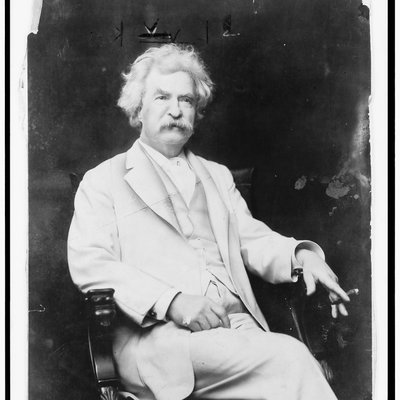
Public domain
Quotes
"The modern patriotism, the true patriotism, the only rational patriotism, is loyalty to the Nation all the time, loyalty to the Government when it deserves it."
"We haven't all had the good fortune to be ladies; we haven't all been generals, or poets, or statesmen; but when the toast works down to the babies, we stand on common ground."
"The difference between the almost right word and the right word is really a large matter—'tis the difference between the lightning-bug and the lightning."
"There is no God, no universe, no human race, no earthly life, no heaven, no hell. It is all a Dream, a grotesque and foolish dream. Nothing exists but you. And You are but a Thought — a vagrant Thought, a useless Thought, a homeless Thought, wandering forlorn among the empty eternities."
"The easy confidence with which I know another man's religion is folly teaches me to suspect that my own is also."
"Against our traditions we are now entering upon an unjust and trivial war, a war against a helpless people, and for a base object — robbery. At first our citizens spoke out against this thing, by an impulse natural to their training. Today they have turned, and their voice is the other way. What caused the change? Merely a politician's trick — a high-sounding phrase, a blood-stirring phrase which turned their uncritical heads: Our Country, right or wrong! An empty phrase, a silly phrase. It was shouted by every newspaper, it was thundered from the pulpit, the Superintendent of Public Instruction placarded it in every schoolhouse in the land, the War Department inscribed it upon the flag. And every man who failed to shout it or who was silent, was proclaimed a traitor — none but those others were patriots. To be a patriot, one had to say, and keep on saying, "Our Country, right or wrong," and urge on the little war. Have you not perceived that that phrase is an insult to the nation? For in a republic, who is "the Country"? Is it the Government which is for the moment in the saddle? Why, the Government is merely a servant — merely a temporary servant; it cannot be its prerogative to determine what is right and what is wrong, and decide who is a patriot and who isn't. Its function is to obey orders, not originate them. Who, then, is "the country?" Is it the newspaper? Is it the pulpit? Is it the school-superintendent? Why, these are mere parts of the country, not the whole of it; they have not command, they have only their little share in the command. They are but one in the thousand; it is in the thousand that command is lodged; they must determine what is right and what is wrong; they must decide who is a patriot and who isn't."
"Ah, it was worth ten years of a man’s life to be dead then! Everything was pleasant. I was in a good neighbourhood, for all the dead people that lived near me belonged to the best families in the city."